
Demystifying AI and Automation: Unraveling the Key Differences
Artificial intelligence (AI) and automation are terms often used interchangeably, yet they represent distinct technological concepts with unique functions and applications. This article aims to clarify these differences, examine their individual roles, and explore how they integrate to shape modern industries.
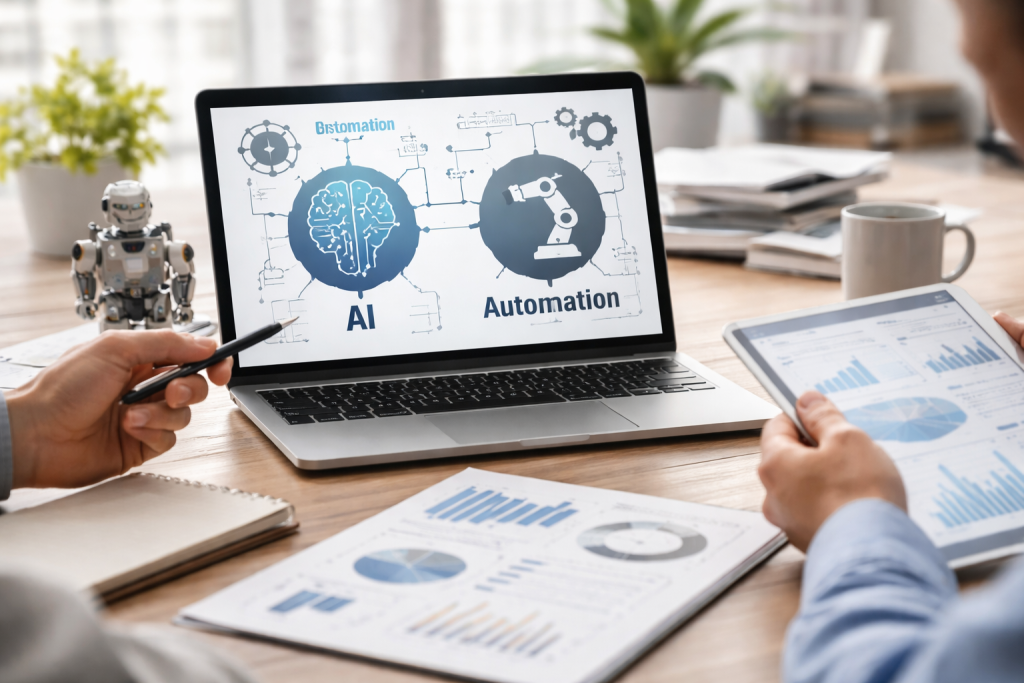
To grasp the advanced applications of AI and automation, we must first define their core principles. Consider a factory production line. Automation might involve robotic arms performing repetitive spot welds, a pre-programmed sequence executed without deviation. AI, in contrast, might be a system analyzing weld quality in real-time, learning from previous defects to suggest adjustments to the welding parameters.
Contents
- 0.1 Defining Artificial Intelligence
- 0.2 Defining Automation
- 0.3 AI’s Impact on Data Analysis and Decision-Making
- 0.4 AI in Personalization and User Experience
- 0.5 Automation for Repetitive Task Execution
- 0.6 Automation in System Control and Monitoring
- 0.7 AI Enhancing Automated Processes
- 0.8 Automation Providing Data for AI Learning
- 0.9 The Myth of Fully Autonomous AI Taking Over
- 0.10 The Myth of Automation Eliminating All Jobs
- 0.11 Opportunities for Innovation and Efficiency
- 0.12 Ethical Considerations and Societal Impact
- 1 FAQs
- 1.1 1. What is the difference between AI and automation?
- 1.2 2. How do AI and automation work together?
- 1.3 3. What are the common misconceptions about AI and automation?
- 1.4 4. What is the impact of AI and automation on industries?
- 1.5 5. What are the opportunities and challenges in the future of AI and automation?
Defining Artificial Intelligence
Artificial intelligence refers to the simulation of human intelligence in machines programmed to think like humans and mimic their actions. Key aspects of AI include learning, reasoning, problem-solving, perception, and language understanding. AI systems are designed to process information, identify patterns, and make decisions or predictions based on data. This capability allows AI to adapt and improve its performance over time without explicit human intervention for every scenario. Think of AI as a sophisticated student constantly absorbing new information and refining its understanding. It’s not just following instructions; it’s learning how to learn. For example, a recommendation engine on a streaming platform observes your viewing habits and suggests new content. It doesn’t just show you what someone else liked; it attempts to understand your preferences and predict what you might enjoy next.
Defining Automation
Automation, in its simplest form, involves the use of technology to perform tasks with minimal human intervention. These tasks are typically repetitive, rule-based, and predictable. Automation systems are programmed to execute specific sequences of actions or processes. They are efficient at performing predetermined operations consistently and accurately. Imagine a thermostat in your home. It automatically turns the heating or cooling on and off to maintain a set temperature. This is a clear example of automation; it follows a simple, pre-defined rule. Automation is about mechanizing processes. It takes a job previously done by a person and provides a mechanical or computational means to do it. Its primary goal is to increase efficiency, reduce costs, and minimize human error in routine operations.
AI has moved beyond academic research and into practical applications across various sectors. Its ability to process vast datasets and discern complex relationships makes it an invaluable tool for tasks that demand intellect.
AI’s Impact on Data Analysis and Decision-Making
One of AI’s most significant contributions is its capacity to analyze massive amounts of data with speed and precision that surpasses human capabilities. Machine learning algorithms, a subset of AI, can identify trends, anomalies, and correlations that might be invisible to human observers. This ability is crucial for informed decision-making in fields ranging from finance to healthcare. For instance, in financial markets, AI can analyze historical trading data to predict market movements, informing investment strategies. In medical diagnosis, AI can analyze imaging scans, assisting radiologists in detecting subtle signs of disease earlier. AI acts as a powerful lens, clarifying complex data landscapes.
AI in Personalization and User Experience
AI plays a critical role in tailoring experiences to individual users. Recommendation systems, found on e-commerce sites and media platforms, leverage AI to suggest products or content based on past interactions and preferences. Conversational AI, exemplified by chatbots and virtual assistants, provides personalized customer service and information retrieval. These AI applications enhance user engagement and facilitate more intuitive interactions with technology. It’s like having a personal assistant who remembers your preferences and anticipates your needs. For example, a smart music player might learn your listening habits throughout the day and automatically curate playlists to match your mood or activity level.
Automation focuses on operational efficiency and reliable execution of defined processes. It is the practical arm of technological implementation, consistent and tireless.
Automation for Repetitive Task Execution
The core strength of automation lies in its ability to execute repetitive tasks with high accuracy and speed. In manufacturing, robotic arms perform assembly, welding, and painting with consistency. In business process automation (BPA), software robots (bots) handle tasks like data entry, invoice processing, and report generation. These automated systems reduce the burden of mundane work on human employees, freeing them for more complex and creative endeavors. Think of automation as a highly disciplined drone, executing its programmed flight path perfectly every time. This precision prevents human fatigue and error, leading to better quality and faster turnaround times.
Automation in System Control and Monitoring
Automation is crucial for controlling and monitoring various systems, from industrial machinery to smart home environments. Programmable logic controllers (PLCs) in factories regulate production lines, ensuring precise timing and coordination. Building management systems automate lighting, heating, and security to optimize energy consumption and safety. These systems operate autonomously according to predefined rules, maintaining optimal conditions and alerting human operators only when deviations occur. This is akin to a vigilant sentinel, constantly checking parameters and reacting appropriately within its pre-set boundaries. An automated quality control system on a production line, for instance, might use sensors to detect flaws in products and automatically divert them for rework, all without direct human supervision during the process.
While distinct, AI and automation are often combined to create systems with greater capabilities than either could achieve alone. Their synergy represents a significant advancement in technological application.
AI Enhancing Automated Processes
AI can significantly improve the effectiveness and flexibility of automation. Traditional automation follows a rigid set of instructions (if X, then Y). When AI is integrated, the automated system can become more intelligent and adaptive. For example, an automated manufacturing line might use AI to monitor product quality. If the AI detects a recurring defect, it could automatically adjust the machine parameters to correct the issue, rather than simply flagging it for a human operator. This turns a simple automated process into a self-optimizing one. AI provides the “brain” to the “brawn” of automation. It elevates automation from merely executing commands to understanding and adapting its execution.
Automation Providing Data for AI Learning
Conversely, automated systems generate vast amounts of operational data, which is essential for training and improving AI algorithms. Sensors on automated machinery continuously collect data on performance, environmental conditions, and output quality. This data can then be fed into AI models, allowing them to learn patterns, predict failures, and optimize processes. An automated logistics system, for instance, might track the movement of thousands of parcels daily. This data can be analyzed by an AI to optimize delivery routes, predict potential delays, or even anticipate demand fluctuations. Automation creates the raw material for AI’s intelligence. Without the consistent and high-volume data produced by automated processes, many AI applications would lack the necessary learning input.
The rapid evolution of AI and automation has given rise to a number of misunderstandings. Addressing these can provide a clearer picture of their capabilities and limitations.
The Myth of Fully Autonomous AI Taking Over
A pervasive myth is that AI is on the verge of developing consciousness or of becoming a completely autonomous entity that will sideline human control. While AI systems are becoming increasingly sophisticated, they operate within the parameters of their programming and the data they are trained on. They do not possess consciousness, emotions, or independent goals outside their designed function. The “takeover” narrative often stems from science fiction and sensationalized media reports. Current AI focuses on specific tasks, like recognizing images or translating languages, not on general intelligence that rivals or replaces human intellect in all its facets. Think of AI as specialized tools rather than general-purpose intelligent beings. A highly advanced calculator can perform complex mathematical operations, but it cannot write a poem or experience joy.
The Myth of Automation Eliminating All Jobs
Another common concern is that automation will lead to widespread unemployment, making human labor redundant. While automation undoubtedly displaces some jobs, particularly those involving repetitive, manual tasks, it also creates new jobs and enhances human productivity in others. Automation often shifts the focus of human work from execution to supervision, maintenance, design, and innovation. For example, a factory might automate its assembly line, reducing the need for manual assemblers. However, it will now require more robotics engineers, data analysts to optimize the automated process, and maintenance technicians to service the machinery. Automation transforms the nature of work, rather than simply eradicating it. It’s like the transition from horse-drawn carriages to automobiles; while some jobs disappeared, many more new ones emerged in manufacturing, sales, and service of the new technology.
The combined trajectory of AI and automation promises transformative changes across society, presenting both promising opportunities and significant challenges that require careful consideration.
Opportunities for Innovation and Efficiency
The continued integration of AI and automation offers vast opportunities for innovation. In healthcare, AI-powered automation can accelerate drug discovery, personalize treatment plans, and improve diagnostic accuracy. In logistics, AI can optimize supply chains, while automated systems manage warehouses and delivery. Smart cities can leverage these technologies to manage traffic, conserve energy, and improve public safety. These advancements lead to greater efficiency, reduced waste, and the creation of new products and services previously unimaginable. Imagine AI-driven environmental monitoring systems that automatically deploy robotic interventions to clean up pollution, or automated farms that precisely manage resources to ensure optimal crop yields.
Ethical Considerations and Societal Impact
As AI and automation become more prevalent, ethical considerations gain increasing importance. Issues such as data privacy, algorithmic bias, and the impact on employment and societal equity must be carefully addressed. Ensuring fairness in AI algorithms, protecting sensitive personal data used for training AI, and developing strategies to support workers affected by automation are crucial. Society must navigate these challenges thoughtfully to harness the benefits of these technologies while mitigating potential risks. This requires ongoing dialogue between technologists, policymakers, ethicists, and the public to shape a future where AI and automation serve human well-being and progress. It is a shared responsibility, like charting a course for a ship, where all members of the crew must contribute to avoid hazards and reach the desired destination.
FAQs
1. What is the difference between AI and automation?
AI, or artificial intelligence, refers to the ability of a machine or computer program to think and learn, while automation refers to the use of technology to perform tasks with minimal human intervention. AI involves the simulation of human intelligence in machines, enabling them to learn from experience, adapt to new inputs, and perform human-like tasks. Automation, on the other hand, involves the use of technology to streamline and automate repetitive tasks, often without the need for human intervention.
2. How do AI and automation work together?
AI and automation work together by leveraging AI’s ability to analyze and interpret data to make decisions, and automation’s ability to execute tasks based on those decisions. AI can be used to analyze large amounts of data and identify patterns or trends, which can then be used to automate processes and make decisions in real-time. This combination of AI and automation can lead to increased efficiency, improved accuracy, and the ability to handle complex tasks that would be difficult or time-consuming for humans to perform.
3. What are the common misconceptions about AI and automation?
Common misconceptions about AI and automation include the belief that AI will replace human jobs entirely, that automation is only relevant in manufacturing or industrial settings, and that AI is only accessible to large corporations. In reality, AI and automation can complement human work, automation is relevant in various industries, and AI technology is becoming more accessible to businesses of all sizes.
4. What is the impact of AI and automation on industries?
The impact of AI and automation on industries is significant, as they can lead to increased productivity, cost savings, improved quality, and the ability to handle complex tasks. However, they can also lead to job displacement and the need for workers to acquire new skills to remain relevant in the workforce. Overall, AI and automation have the potential to transform industries and create new opportunities for growth and innovation.
5. What are the opportunities and challenges in the future of AI and automation?
The future of AI and automation presents opportunities for improved efficiency, innovation, and the development of new products and services. However, it also poses challenges such as ethical considerations, job displacement, and the need for regulations to ensure responsible use of AI technology. As AI and automation continue to advance, it will be important for businesses and policymakers to address these challenges while harnessing the potential benefits.

Sarah Khan is a technology enthusiast and the admin of ProTechTuto. Her goal is to provide clear, practical, and easy-to-understand tech guides for beginners, helping them build strong digital skills with confidence.